This is another one you can do as a pilot or owner, no A&P needed!
If you want, get the box that your spark plugs came in, or a picture of them – just so you can read the numbers. It’ll be easier to follow along in this article.
You’re plugs have 3 parts: center electrode, ceramic insulator, and barrel. The ceramic insulator is made of aluminum oxide ceramic for strength, heat conductivity, and it’s dielectric properties. They come in massive electrode and fine wire options.
The numbering scheme…
This got me early in my career. I just didn’t make time to understand it. The numbers provide info on the design, type, and specs of your plug.
I was originally going to describe the different letters, numbers and options you have, but this image from Savvy Aviation captures it best to me.
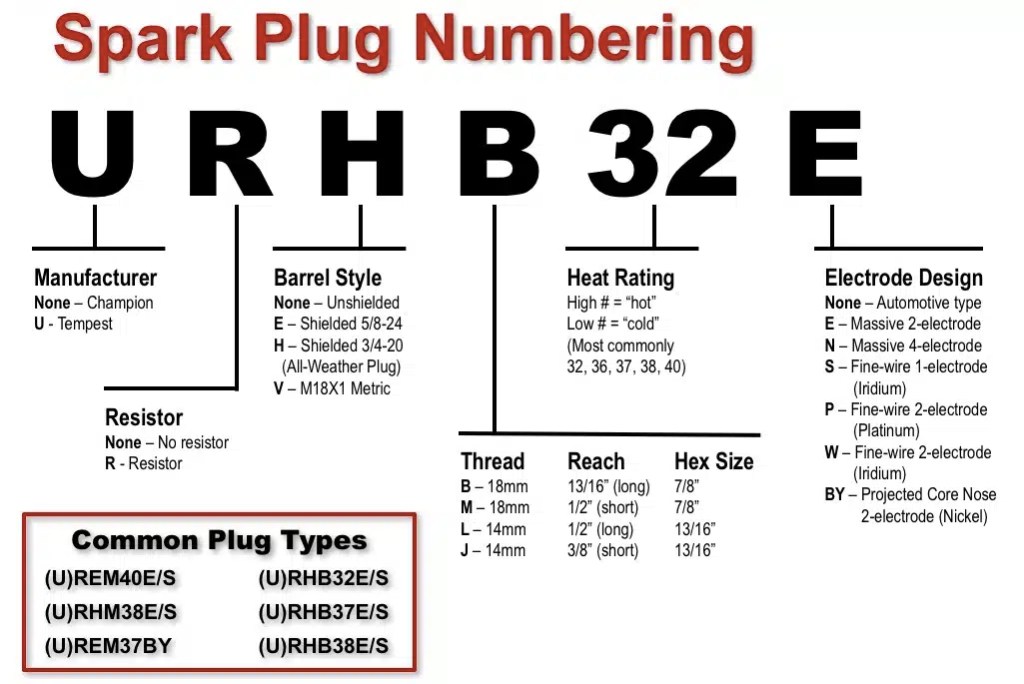
It’s worth paying attention to the barrel style as you can get the right plugs but the wrong barrel style and it won’t fit your ignition leads! Ask me how I know…
The next position is a letter that tells you the “reach” of the plug, or how long the threads are that run into your cylinder head. Don’t experiment with this one or you may soon order pistons lol!
The next thing is the heat rating, or the plug’s ability to transfer heat to the cylinder head. “Hot” plugs have a longer insulator nose so it has more area to get rid of the heat, but hot enough to not foul out (due to carbon or oil buildup). “Cold” of course are shorter insulator noses and are usually used in higher compression engines. I think turbos generally use them as well.
And last is the electrode itself, which comes in a few different flavors.
Massive 2 electrode is by far the most common I’ve seen.
Fine wire will last around 2x as long, but cost about 2x as much, so no gains there. I rarely see these, but they’re out there!
BY is a protruded nose plug common on Cessna 152’s. Seen on both Lycoming and Continentals. They reduce fouling problems on lower compression engines like O-200’s and O-235’s and seem to help cold starts – just been my experience.
When to change?
It’s been a rule of thumb to clean and gap them about every 100 hrs. This is a good time to get a visual on the condition of the plug itself, and how rich or lean the engine has been running (generally).
I have flown with guys that’ll check them in flight by running Lean-Of-Peak (LOP) and do a mag check then. The performance can tell you if you need to check them out or not. Pretty useful if you ask me, given how involved some cowlings are to remove!
When you go to install the plugs, Continentals call for 20-30ft-lbs torque.
Lycomings call for 30-35ft-lbs torque.
Ignition lead caps torque to 10ft-lbs (120 in-lbs) don’t over torque it! Again, ask me how I know…
There’s a bit more to cover that’s related but that’ll be for another article as the subject can veer off in a few directions and get into the weeds quick! We’ll tackle those in separate articles!
 Spinning Levers, LLC
Leave a comment